
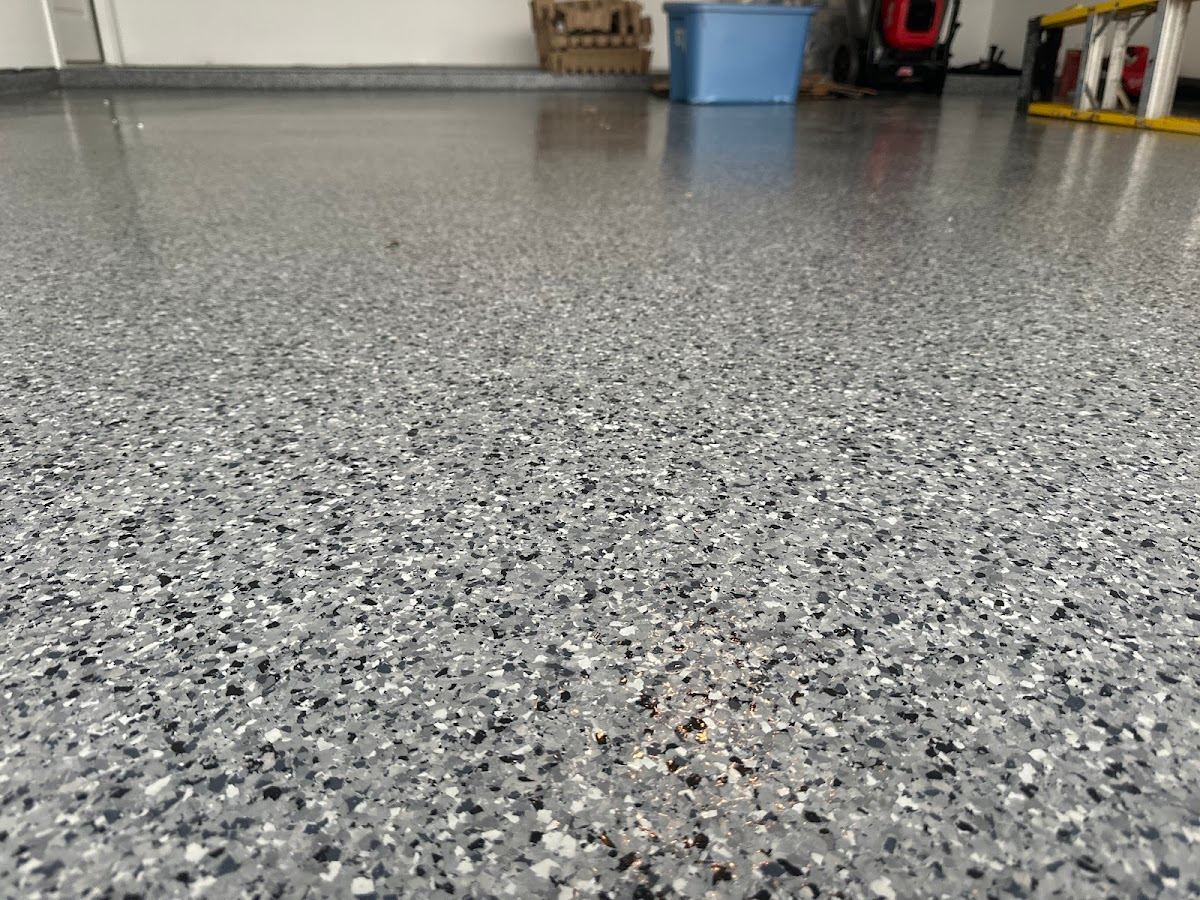
If you have ever stepped into a garage, gym, or showroom with a clean, speckled floor that looked tough and finished at the same time, you were almost certainly looking at flake epoxy. It is the most popular floor coating we install across League City and Greater Houston because it nails all three things homeowners and business owners actually want: it looks sharp, it hides the everyday mess of real life, and it holds up to Gulf Coast heat, humidity, and slab moisture better than almost anything else you can put on bare concrete. This guide breaks down the real flake epoxy floors benefits and cost picture, with no invented prices and no fluff.
What is a flake epoxy floor?
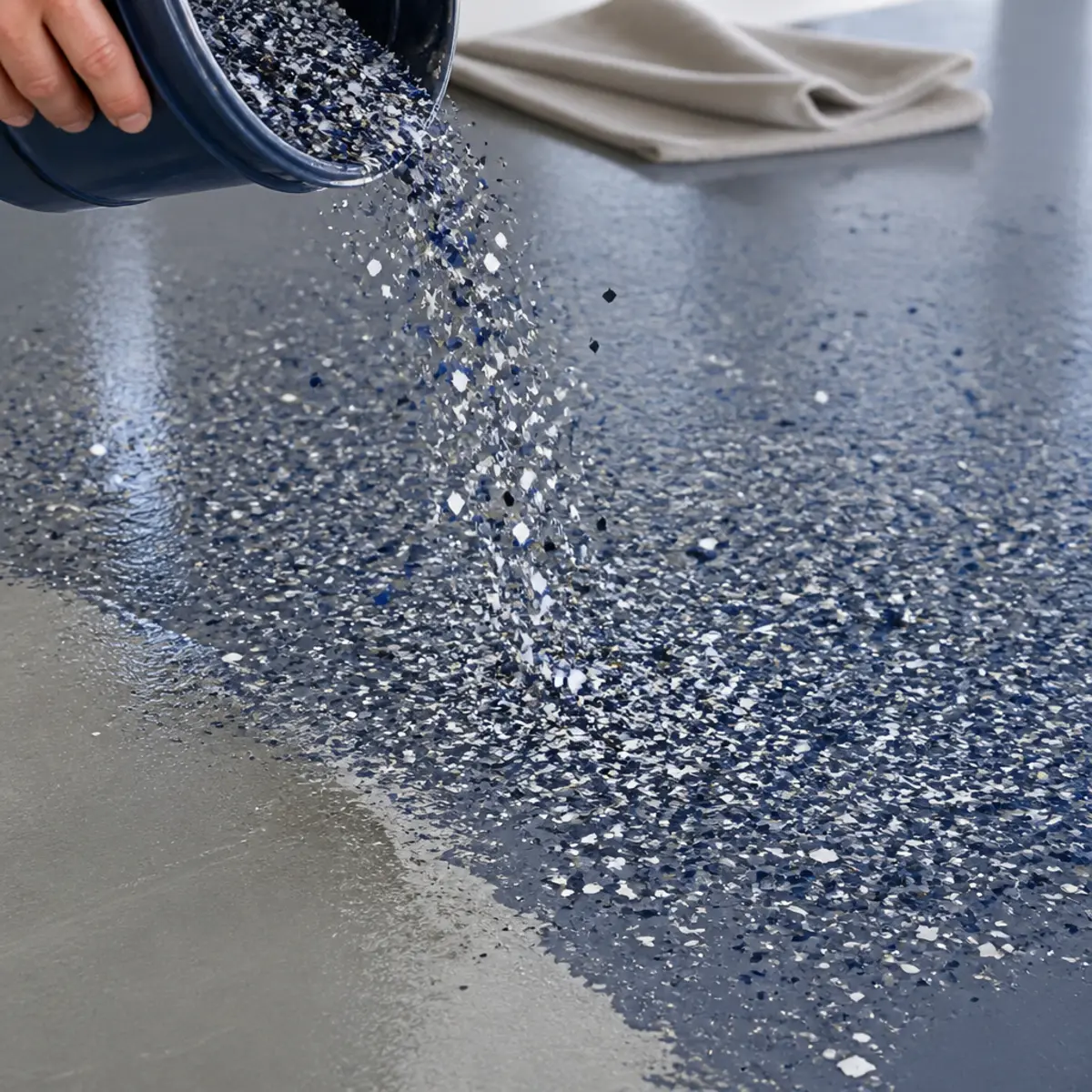
A flake epoxy floor, also called chip epoxy or decorative flake, is a multi-layer coating system built directly on your concrete slab. After the surface is mechanically ground and prepped, we roll out a colored epoxy base coat. While that base is still wet, we hand-broadcast vinyl color chips, or "flakes," across it. Those flakes are what give the floor its signature speckled, granite-like look.
Once the base cures, we scrape off the loose chips and seal everything under one or more clear topcoats. That topcoat locks the flakes in place, builds the durable wear surface, and gives the floor its sheen. The result is a seamless, non-porous floor with depth and texture instead of a flat painted finish.
A typical professional flake system has four layers:
| Layer | What it does |
|---|---|
| Surface prep / primer | Opens the concrete and creates the mechanical bond |
| Pigmented epoxy base | Carries color and holds the broadcast flakes |
| Vinyl flake broadcast | Adds color, texture, traction, and hides flaws |
| Clear topcoat (epoxy or polyaspartic) | Seals, builds wear resistance, and sets the gloss |
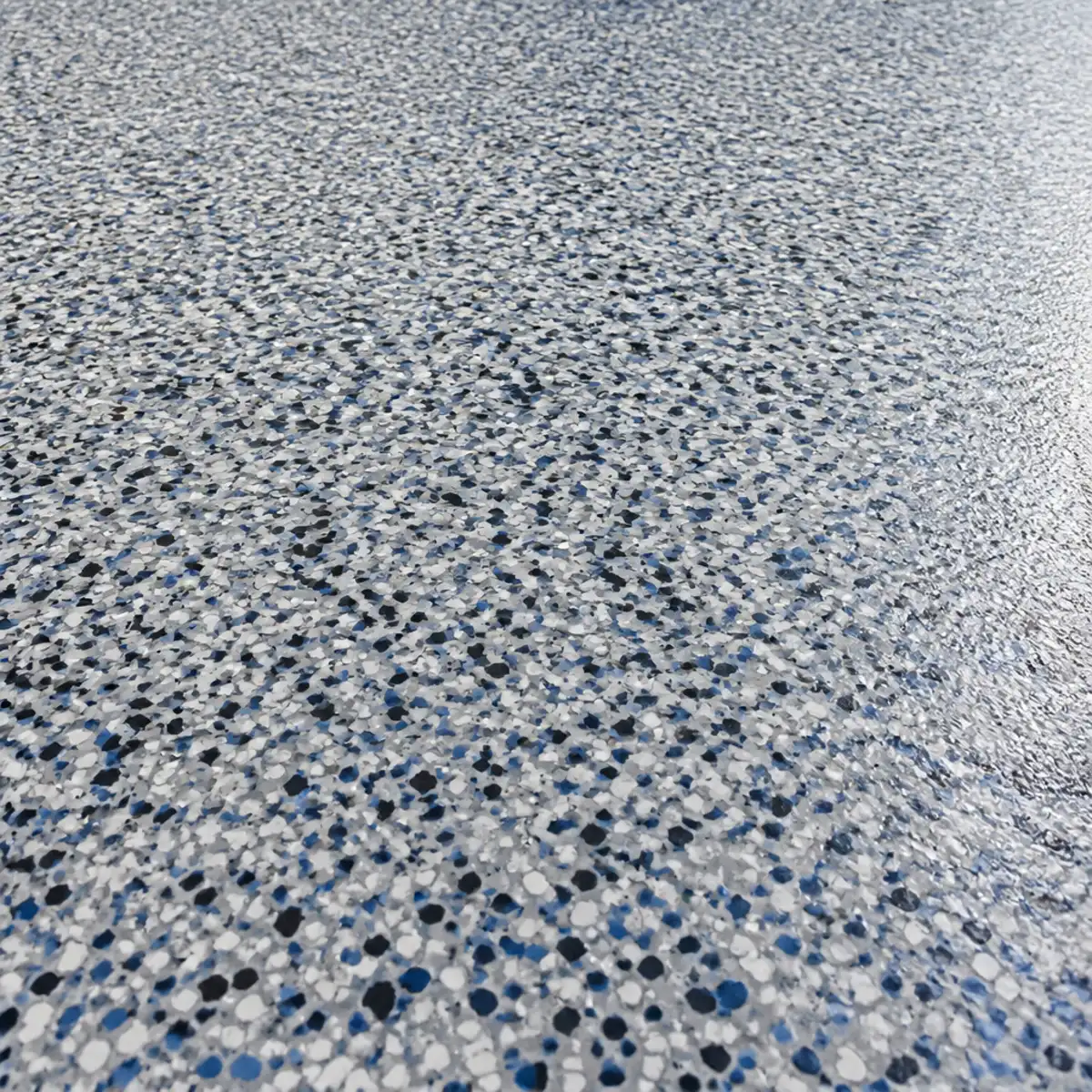
You can dial in the look two ways. A full broadcast packs flakes edge to edge until almost no base color shows, which hides the most and reads as the richest texture. A light broadcast scatters fewer flakes so the base color stays visible, for a cleaner, more subtle finish. Same system, very different vibe.
Benefits of flake epoxy floors
Durability that outlasts the alternatives
The combination of a bonded epoxy base, embedded vinyl chips, and a hard clear topcoat creates a surface that shrugs off the things that wreck ordinary garage and shop floors: dropped tools, hot tires, rolling toolboxes, and constant foot traffic. A properly installed, professionally prepped flake floor commonly lasts 15 to 20 years in a residential garage. That is the difference between a real coating system and a DIY roll-on kit, which often starts peeling in 3 to 7 years because the prep and film thickness were never there.
Slip resistance for a wet climate
The flake texture sitting under the topcoat adds genuine traction underfoot, which matters in a region where humidity and tracked-in water are a daily fact of life. For patios, entryways, and pool-adjacent areas, we can broadcast extra anti-slip aggregate into the topcoat to push the grip even higher.
Hides imperfections and everyday dirt
Most slabs are not showroom-perfect, and they do not need to be. The mottled flake blend camouflages minor surface flaws, patch lines, and the dirt that collects between cleanings. A solid-color floor shows every footprint and leaf; a flake floor quietly hides them.
Easy to clean and chemical resistant
Because the finished floor is seamless and non-porous, there are no grout lines, pores, or seams for grime to settle into. Spills wipe up, and oil, antifreeze, and most household chemicals stay on the surface instead of soaking into the concrete. Dust and dirt sweep or mop away in minutes.
Custom color and brand matching
This is where flake gets fun. Chips come in dozens of stock colors and can be mixed into custom blends, so you can match a home's decor or a business's brand palette. We build the blend and show you a physical sample board before a single drop of epoxy hits the floor. If you want more of a marbled, three-dimensional effect instead, our metallic epoxy floors are worth a look, and our metallic epoxy flooring ideas post walks through the options.
What affects the cost of a flake epoxy floor
There is no honest flat price for a flake floor, and you should be cautious with anyone who quotes one sight unseen. National figures usually land flake systems in the mid-range of coating prices, well above a paint kit and below high-end metallic or terrazzo work, but your real number depends on the slab in front of us. These are the drivers that actually move it:
- Square footage. Bigger floors cost more in total, though the per-square-foot rate usually improves as the area grows, because mobilization and setup get spread over more space.
- Slab and prep condition. This is the big one, and on most jobs surface prep is the largest single share of the labor. Mechanical surface preparation, grinding the concrete open so the coating bonds for the long haul, is non-negotiable. A clean, sound slab preps fast; one with old coatings, paint, oil saturation, or heavy contamination takes far more work.
- Repairs needed. Cracks, spalls, pitting, and divots get fixed before any color goes down. More repair means more labor and material.
- Flake density. A full broadcast uses more flake material than a light broadcast, so it costs a bit more.
- System thickness. A thicker, higher-solids build is more durable and costs more than a thin economy coat. For a floor that sees vehicle weight, that extra mil thickness is what keeps it from wearing through.
- Topcoat choice. A standard epoxy topcoat and a UV-stable polyaspartic topcoat are not the same price, and they are not the same product. More on that next.
The right way to get a real number is to have someone actually assess your floor. We do that for free, then put the price in writing so there are no surprises. If you are weighing this against a grind-and-seal finish, our epoxy flooring vs polished concrete comparison lays out the tradeoffs.
Epoxy vs. polyaspartic topcoat: which finish you actually need
The topcoat is the layer that lives with the weather and the wear, so the choice matters more than most people realize.
| Epoxy topcoat | Polyaspartic topcoat | |
|---|---|---|
| UV stability | Can amber and chalk in sun | Stays clear, non-yellowing |
| Cure speed | Slower; longer between coats | Fast; often recoatable same day |
| Best for | Interior, shaded garages | Sun-exposed patios, fast turnarounds |
| Hot-tire & abrasion resistance | Strong | Excellent |
For interior garages and shops that never see direct sun, a quality epoxy clear is a sound, cost-effective choice. For anything that catches sun, patios, porches, or garages with the door open all day, we finish with a UV-stable polyaspartic topcoat. It holds its color, cures fast even in our heat, and adds extra abrasion resistance. Many of our garage floor coatings use exactly this kind of hybrid build for the best of both.
How the installation works and how long it takes
A professional flake install is a multi-day, multi-step process, and the timeline is built around cure windows, not how fast we can roll product.
- Diamond grind and prep. We open the slab mechanically. Skipping or shortcutting this is the number one reason coatings fail. Our concrete grinding before epoxy post explains why.
- Repair and moisture check. Cracks and spalls get filled; on slab-on-grade we test for moisture before we coat.
- Base coat and flake broadcast. Color goes down and flakes are broadcast to refusal while it is wet.
- Scrape and topcoat. Loose chips come off, then one or more clear coats seal the floor.
Plan on a roughly 2-to-4 day project. The floor is usually walkable in about 24 hours after the final coat, and ready for vehicle traffic in several days, since full chemical cure can take up to about a month. Polyaspartic topcoats shorten the return-to-service time considerably.
Best uses for flake epoxy
Flake is one of the most versatile coatings out there, which is why we install it in so many settings:
- Garages. The classic application. It handles tires, tools, and traffic while looking finished. See our best flooring options for Texas garages for how it stacks up.
- Patios and front porches. A covered patio with a UV-stable topcoat and anti-slip aggregate becomes a finished outdoor room.
- Mudrooms, laundry rooms, and entries. High-traffic, mess-prone spaces where easy cleanup is a real win.
- Retail showrooms and offices. A durable, branded floor with the polish of tile and none of the grout upkeep, often through our commercial epoxy flooring work.
- Gyms and fitness studios. Tough enough for dropped weights and constant foot traffic.
- Vet clinics, salons, and service floors. Seamless and sanitary, with a custom look that fits the space.
Flake epoxy on the Texas Gulf Coast
This is where the right system earns its keep. The Gulf Coast throws three things at a floor that generic coatings often cannot handle: intense UV, high humidity, and slab moisture.
For anything that sees sun, a standard epoxy clear can amber and chalk over time, which is why sun-exposed flake floors get a UV-stable polyaspartic topcoat here. Humidity is the second factor, and it is why slip resistance is not optional; the flake texture plus anti-slip additive keeps footing sure when a floor gets damp.
The third factor is the one most homeowners never think about: slab moisture. Concrete on a Gulf Coast slab-on-grade wicks moisture up from the ground, and that vapor pressure pushing up through the slab is the leading cause of coatings that bubble, delaminate, and peel. Proper diamond grinding and, when needed, moisture testing and mitigation are what keep a flake floor bonded for years. Getting the concrete coatings prep right is the difference between a floor that lasts and one that lifts in a couple of seasons. It is the part you cannot see, and the part that matters most. Our how long does epoxy flooring last guide goes deeper on what makes a coating go the distance.
Keeping a flake floor looking new
Flake floors are low-maintenance, not no-maintenance. Sweep or dust-mop regularly, because fine grit acts like sandpaper under tires and feet and slowly abrades the topcoat. Clean with a pH-neutral cleaner and a soft mop, skip harsh acids and abrasive pads, and wipe spills when they happen. Done consistently, that simple routine is most of what stands between you and a topcoat refresh years down the road. Our how to maintain an epoxy garage floor post has the full routine.
Why choose South Coast Epoxy
Andrew and the crew install custom decorative flake epoxy for homes and businesses throughout the region, including League City, Houston, Clear Lake, Kemah, and the surrounding Gulf Coast communities. We are locally owned, we know exactly what our climate does to a slab, and we prep every floor for the conditions it will actually live in.
We do not cut corners on surface prep, we repair before we coat, and we will build a custom flake blend on a sample board so you can see what you are getting before we start. With 57 reviews and a 4.9 rating behind our residential and commercial work, we would rather earn your trust with a floor that holds up than with a sales pitch.
Love the flake look? Email info@southcoastepoxy.com for a custom color blend and a free quote, or reach out through our contact page. Tell us about your space and we will help you choose the right system for it.
Frequently Asked Questions
How much does a flake epoxy floor cost?
Cost depends on square footage, slab and prep condition, flake density, and the topcoat you choose. There is no flat price - we give you a free quote after we look at your actual floor.
Is flake epoxy slippery?
No. The flake texture sitting under the topcoat adds traction, and we can add extra anti-slip aggregate for wet areas like patios and pool decks.
Can flake epoxy go on a patio in Texas?
Yes. With a UV-stable polyaspartic topcoat and proper surface prep, flake systems work well on covered patios and front porches across the Gulf Coast.
Does flake epoxy hide cracks and stains?
The flake blend camouflages minor imperfections and everyday dirt between cleanings. Structural cracks get repaired during prep first, before any coating goes down.
About South Coast Epoxy
South Coast Epoxy is a locally owned epoxy, polished concrete, and flooring contractor based in League City, TX, serving homeowners and businesses across the Houston Bay Area. Owner Andrew and his crew specialize in durable, great-looking floors built for the Texas Gulf Coast. Get a free quote →