
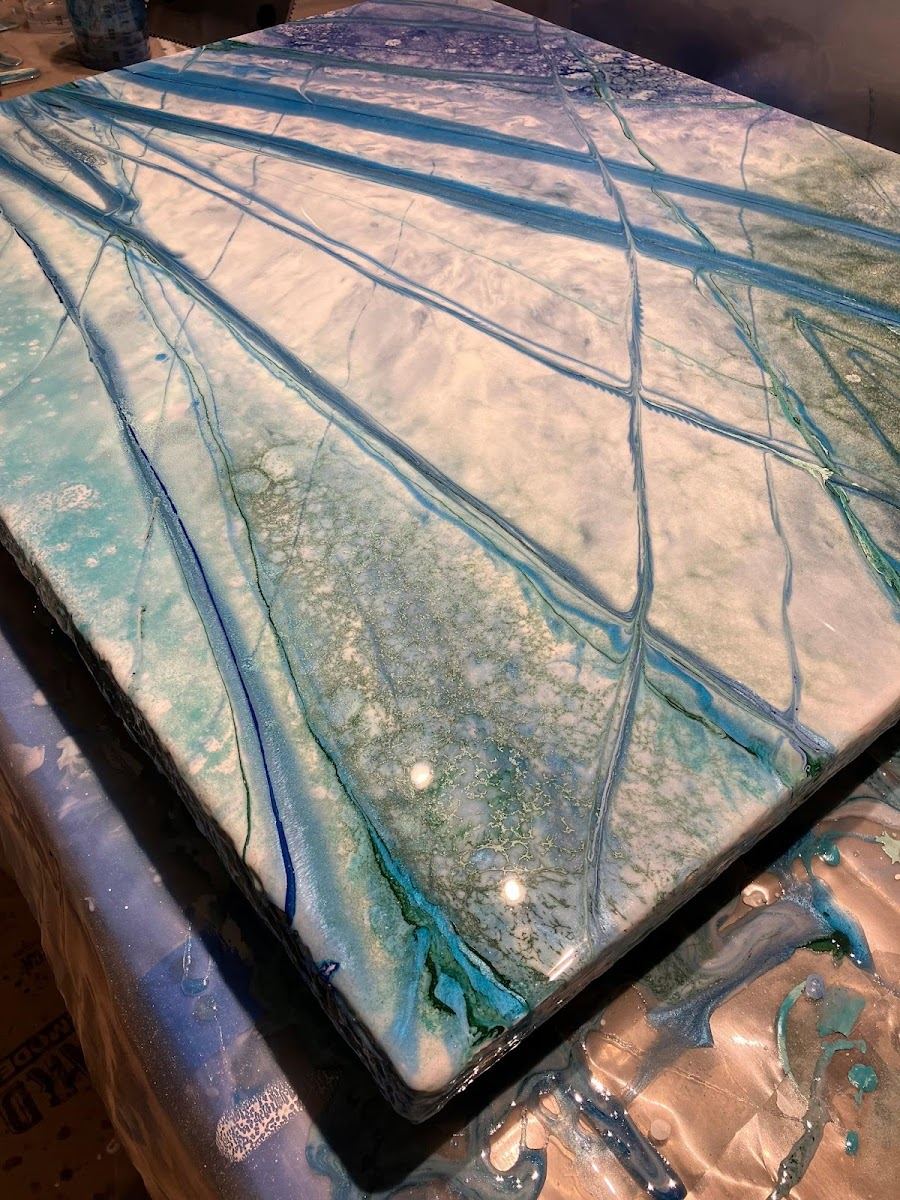
Epoxy countertops can stop you in your tracks. Poured right, they read like swirling marble, moving Gulf water, or molten metal, all in one seamless, glass-smooth surface with zero grout lines. But they are not magic, and they are not the right answer for every kitchen. Before you commit, you deserve a straight, no-spin breakdown of epoxy countertops pros and cons, including the heat, humidity, and slab-on-grade realities that shape every surface decision here on the Texas Gulf Coast.
This guide comes from a crew that pours resin for a living. We will cover what epoxy countertops actually are, the genuine advantages, the honest drawbacks, how they stack up against quartz and granite, what really drives the price, and how to keep one looking sharp for years.
What are epoxy countertops?
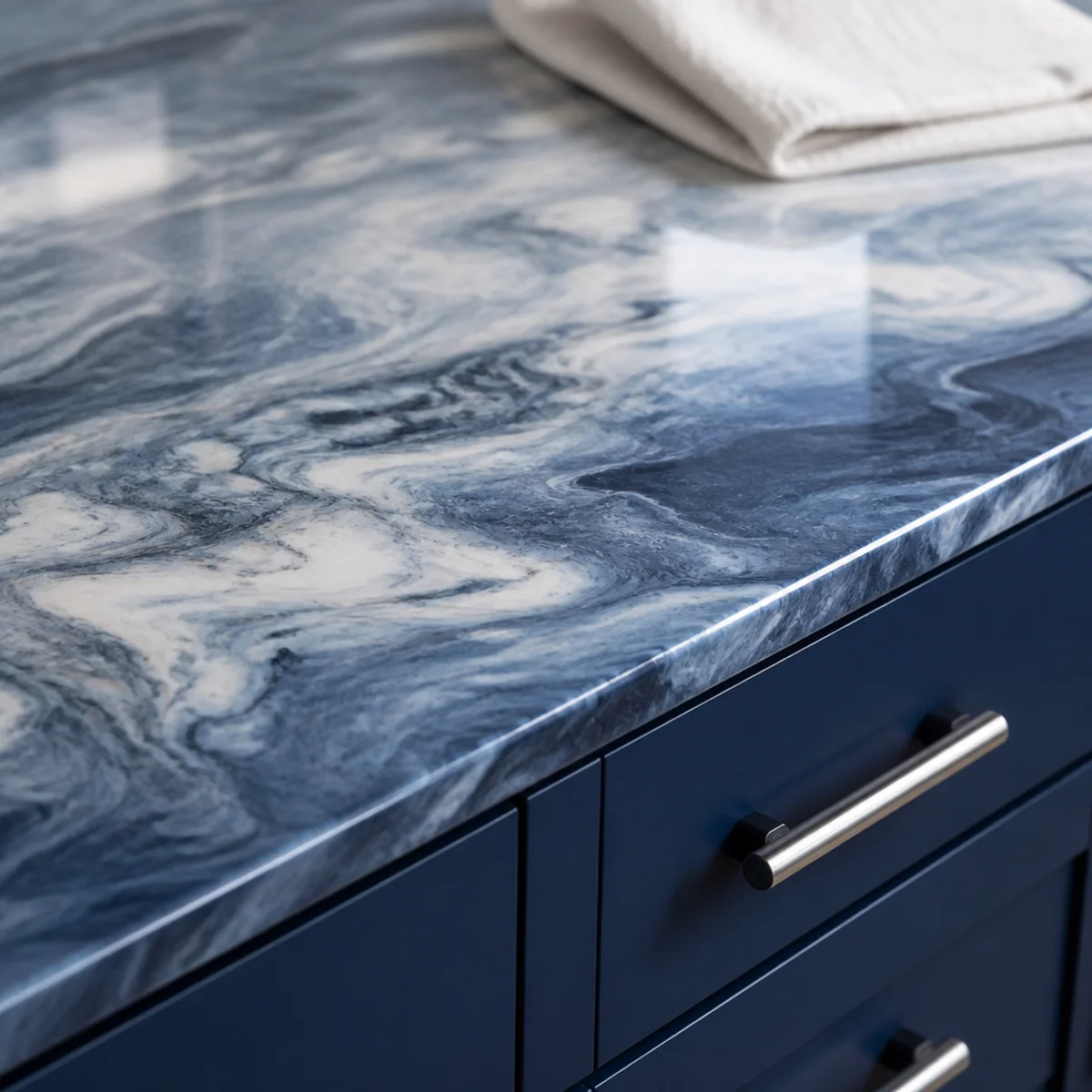
An epoxy countertop is not a slab you buy and set in place. It is a two-part liquid (resin plus hardener) mixed and poured over a substrate, usually an existing countertop, a sheet of plywood or MDF, or a concrete base. The resin self-levels, cures into a rock-hard surface, and bonds to whatever is underneath. The finished product is a single, continuous, glossy top with no seams and no grout lines to trap grime.
Because it starts as a liquid, you can do things with epoxy that stone simply cannot. Color goes in before and during the pour. Pigments, metallic powders, and even embedded objects are worked into the resin while it is still wet, so the pattern lives inside the surface rather than sitting on top of it. That is the heart of why people love them, and also why the installer matters so much: the final look is created by hand, in real time, while the clock is running.
Epoxy countertops pros and cons at a glance
| Factor | The reality |
|---|---|
| Look and customization | Best in class; fully custom, seamless, one of a kind |
| Stain and moisture resistance | Excellent once cured; fully non-porous |
| Heat resistance | Weak point; needs trivets, every time |
| Scratch resistance | Hard but not stone; use cutting boards |
| UV and yellowing | Risk with sun exposure; quality resin and topcoat matter |
| Resurfacing existing counters | Strong advantage; skips demolition |
| DIY difficulty | High; coastal humidity makes it harder |
| Best fit | Design-forward kitchens, islands, bars, low-direct-heat zones |
The rest of this article unpacks each of these honestly.
The pros of epoxy countertops
Seamless, fully customizable looks
This is the headline. Epoxy can convincingly mimic high-end marble, granite, or quartzite at a fraction of the slab cost, and it can also go places stone never could. A deep teal poured to look like Gulf water. A warm gold-and-charcoal metallic finish that shifts with the light. A solid, saturated statement color no stone yard carries. Because the whole top is one continuous pour, no seams interrupt the design, which is a real advantage on a large island or an L-shaped run. Two epoxy counters are never identical, so yours is genuinely one of a kind.
Non-porous and easy to clean
Once cured, epoxy is hard, dense, and completely non-porous. Liquids do not soak in the way they do with untreated stone or laminate, so wine, coffee, and cooking oils wipe right off. There is no grout to scrub and no porous surface to harbor bacteria, which makes daily cleanup genuinely easy. That sealed, monolithic surface is a practical win in our climate, where humidity and spills are facts of life in any League City or Houston kitchen.
Food-safe once cured
A common question: is epoxy safe around food? Once a quality resin has fully cured, it forms an inert, non-toxic, non-porous surface with no seams or gaps for bacteria and mold to hide. As with any countertop, you still want to use a cutting board and clean spills, but a properly poured and cured epoxy top is a hygienic prep surface.
Cost-effective resurfacing
Here is the part that surprises people. In many cases, epoxy can be poured directly over your existing countertop. If your laminate, tile, or worn solid-surface counters are structurally sound but dated, resurfacing with epoxy skips the demolition, the disposal, and the cost of all-new substrate. You get a dramatically different look without tearing the kitchen apart, which makes it a smart move for a refresh on a budget, a rental, or a flip.
The cons of epoxy countertops (the honest version)
No surface is perfect, and we would rather tell you the trade-offs up front than have you learn them the hard way.
Heat sensitivity. This is the big one. Epoxy is heat-resistant but not heatproof. A pot straight off the burner or a hot pan set down without protection can leave a ring, a dull spot, or in a worst case a soft mark. Granite and quartz tolerate far more direct heat. The fix is simple: trivets and hot pads, every single time. It is a habit you have to keep.
It can scratch under abuse. Epoxy is hard, but it is not stone. Cutting directly on the surface will eventually leave marks, and dragging gritty or heavy cookware around can dull the shine over time. Use a cutting board and treat it well, and it stays glossy. Treat it like a butcher block and it will show wear.
UV exposure and yellowing. Lower-quality resins can yellow over time, especially with direct sunlight. This matters in sun-soaked Texas kitchens with big windows or doors to a patio. The defense is a UV-stable resin and a quality protective topcoat, which is exactly why professional product selection beats a bargain kit. A finish built to resist UV holds its color far longer than budget epoxy poured in a sunny room.
DIY pours are genuinely tricky. Online tutorials make this look easy. It is not. A flawless, bubble-free, level finish requires controlling the mix ratio, temperature, timing, and the environment, and a single dust speck or air bubble can mar an otherwise perfect pour. In our humid coastal air, curing behaves very differently than it does in a dry climate, which trips up a lot of weekend attempts. A botched DIY pour usually has to be ground down and redone, so the savings evaporate fast.
The result depends on the installer. The flip side of all that customization is that the outcome lives entirely in the hands doing the work. A beautiful epoxy countertop is a craft, not a kit.
Epoxy vs. quartz, granite, and laminate
There is no single best countertop, only the right one for your kitchen, your budget, and how you cook. Here is the honest comparison.
| Epoxy | Quartz | Granite | Laminate | |
|---|---|---|---|---|
| Custom look | Excellent, one of a kind | Limited patterns | Natural, varies | Printed patterns |
| Seamless | Yes | Visible seams | Visible seams | Seams at joints |
| Heat resistance | Low; use trivets | Moderate | High | Low |
| Scratch resistance | Moderate | High | High | Low |
| Non-porous | Yes | Yes | Needs sealing | Yes |
| Resurface in place | Yes | No | No | No |
If you cook hot and hard every night and never want to think about a trivet, granite or quartz may suit you better. If you want a truly custom, seamless, high-design surface, or you want to transform existing counters without a teardown, epoxy is hard to beat. Many homeowners use epoxy where it shines, such as islands, bars, bathroom vanities, and coffee stations, while reserving heavy-cooking zones for stone. The same flexibility is why epoxy is so popular for custom countertops and accent surfaces.
What drives the cost of epoxy countertops
We will never quote a per-square-foot price sight unseen, because the honest answer is that it depends. Here is what actually moves the number on an epoxy countertop project:
- Condition of the existing surface. Counters that can be resurfaced cost less than projects needing new substrate. Repairs, leveling, or removing a failed previous finish add labor.
- Square footage and layout. A simple straight run pours faster than a multi-level island with a waterfall edge and lots of corners.
- Design complexity. A solid color is straightforward. Hand-pulled marble veining, layered metallics, or embedded objects take more skill and time.
- Edge details. Waterfall edges, built-up profiles, and integrated backsplashes add material and labor.
- Quality of materials. UV-stable, food-safe resins with a durable topcoat cost more than bargain kits, and they are worth it for a surface you live with daily.
- Prep work. Proper surface prep is the difference between a finish that lasts and one that lifts. We do not skip it.
The takeaway: cheap epoxy on bad prep is the most expensive countertop you can buy, because you pay twice when it fails. Honest, fair pricing on quality materials and real prep is the better long-term value.
Are epoxy countertops worth it on the Gulf Coast?
For the right kitchen, absolutely. The Texas Gulf Coast does add a few wrinkles, and knowing them up front is exactly why working with a local crew pays off. Our humidity changes how resin de-gasses and cures, so timing and technique have to be dialed in for coastal conditions rather than copied from a dry-climate tutorial. Strong year-round sun makes UV-stable resin and a protective topcoat non-negotiable in bright kitchens. And the same moisture awareness we bring to slab-on-grade flooring carries straight into countertop work, where a clean, sound substrate is the foundation of a finish that lasts.
Done right, an epoxy countertop holds its gloss for years and gives you a look you cannot get from any slab. Done on the cheap, with the wrong resin in the wrong conditions, it disappoints fast. The material is only as good as the hands and the prep behind it.
Care and maintenance
Keeping an epoxy countertop looking new is mostly good habits, not hard work.
- Use cutting boards. Always. This is the single best thing you can do to protect the finish.
- Use trivets and hot pads. Never set hot cookware directly on the surface. Heat is the main enemy.
- Clean gently. Warm water with mild dish soap, or a non-abrasive cleaner, handles routine cleanup. Skip harsh chemicals, acetone, and abrasive pads, which dull the gloss.
- Wipe spills when you see them. The surface is non-porous, so there is no rush, but a quick wipe keeps everything pristine.
- Mind the sun. In very bright kitchens, a curtain or shade during peak afternoon hours adds insurance against long-term UV change.
Treated this way, the gloss holds for years. If a counter ever loses some shine after a long life of hard use, a professional can often refresh the topcoat rather than replacing the whole surface, the same logic behind ongoing floor repair and maintenance.
Design ideas worth considering
Because the look is built into the pour, your options are wide open:
- Faux marble. A soft white base with gray or gold veining, hand-pulled while the resin flows, so the veins land exactly where you want them.
- Ocean and metallic effects. Blues, teals, and whites layered to mimic moving water, or rich metallics that shimmer with the light. Showstoppers on an island.
- Solid statement colors. Deep charcoal, warm terracotta, or clean bright white poured solid for a modern, architectural feel.
- Waterfall edges. Carry the pour over the side of an island so the surface flows to the floor in one continuous sheet.
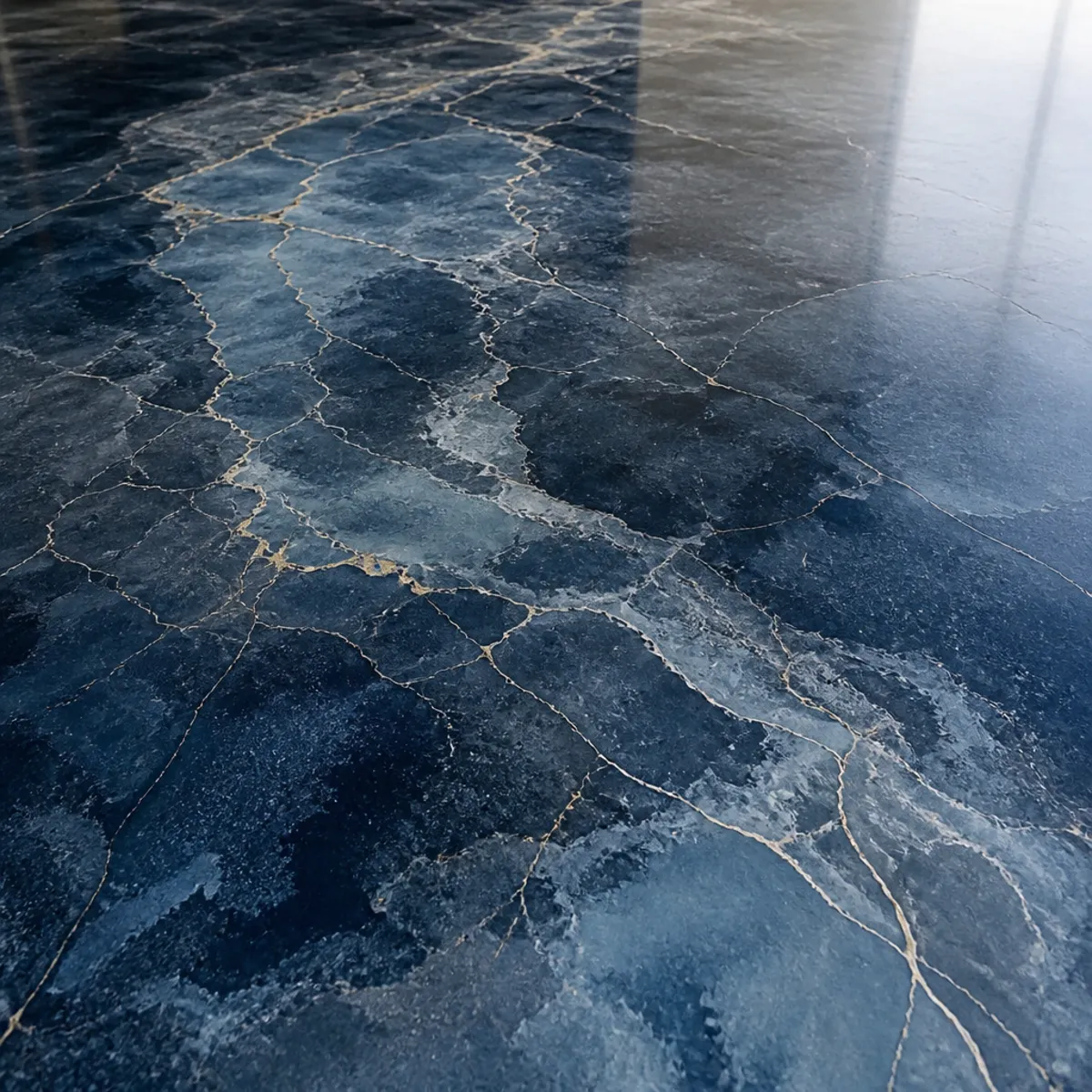
- Matching your floor. If you have or are planning a decorative epoxy floor, we can coordinate the countertop finish so the two share a palette and tie the whole room together. That whole-room cohesion is tough to pull off when a counter and floor come from two different installers.
Custom epoxy countertops by South Coast Epoxy
Andrew and the crew pour custom epoxy countertops for homes across the Gulf Coast, from League City kitchens to Clear Lake and Friendswood homes and throughout the greater Houston area. We handle the whole process: assessing your existing counters, helping you settle on a design, choosing UV-stable and food-safe materials, and pouring a seamless finish built for how you actually live and cook.
Because we install floors too, we can coordinate a countertop with a kitchen or living-space remodel so colors and finishes work together instead of competing. We will give you a straight assessment of whether epoxy is the right call for your space, and if it is not, we will tell you that.
Dreaming up a custom countertop, or wondering whether epoxy can resurface what you already have? Email us at info@southcoastepoxy.com or reach out through our contact page, and we will get back to you with honest answers, real options, and a clear plan for your kitchen.
Frequently Asked Questions
Are epoxy countertops durable?
Yes. They are hard, non-porous, and easy to clean. Use trivets for hot pots and avoid cutting directly on the surface, and a quality install will hold up for years.
Can epoxy go over existing countertops?
Often yes. Epoxy can resurface many existing counters, which avoids a full teardown and lowers the cost of a refresh.
Do epoxy countertops scratch or yellow?
A quality install with a proper topcoat resists scratching and yellowing. Harsh abuse and direct heat are the main risks, so use cutting boards and trivets.
Can my countertop match my epoxy floor?
Yes. We can coordinate metallic or color finishes so a countertop and floor share a cohesive look throughout the room.
About South Coast Epoxy
South Coast Epoxy is a locally owned epoxy, polished concrete, and flooring contractor based in League City, TX, serving homeowners and businesses across the Houston Bay Area. Owner Andrew and his crew specialize in durable, great-looking floors built for the Texas Gulf Coast. Get a free quote →